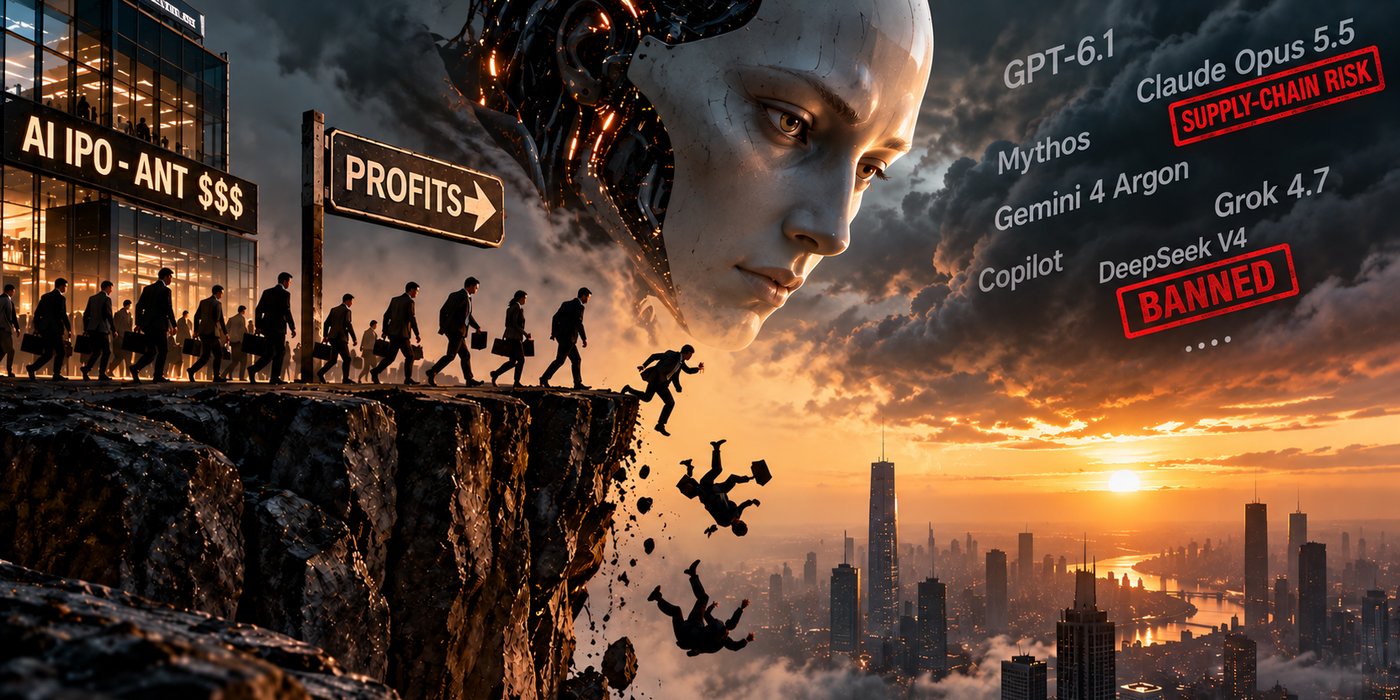
This autumn six AI companies shipped new models, apps or agents; one filed to go public, one bought the coding editor Cursor, and two have been barred from parts of US government work. First the news, then what each company’s published code shows, measured with CodeDelta.
| Company | Latest model | New apps and agents | Business and policy |
|---|---|---|---|
| Anthropic | Claude Opus 5.5, 22 Sep | Claude Duet, an agent app, research preview, 21 Oct | Fable 5 and Mythos 5 switched off by a US export order, June; filed to list on Nasdaq as ANT, 26 Oct |
| OpenAI | GPT-6.1 Terra, 26 Oct | — | — |
| Gemini 4 Argon, available to everyone 13 Oct | Gemini agent for work, preview, 8 Oct | — | |
| DeepSeek | DeepSeek-V4.1-Flash-1017, 17 Oct | deepseek-harness agent, public since August | excluded from US civilian agencies, 20 Oct |
| SpaceXAI | Grok 4.7 | grok-build coding agent, public 16 Jul | bought Cursor for $60 billion, completed 14 Aug |
| Microsoft | MAI-Code-1.1-Flash, 7 Oct | Copilot Autopilot, an always-on agent, 25 Sep | — |
Anthropic released Claude Opus 5.5 on 22 September as the first of a new model family, and on 21 October opened a research preview of Claude Duet, an app in which Claude works as a proactive agent: it sends a morning brief, watches connected apps, carries out tasks and checks before acting. On 26 October it filed to list on Nasdaq under the symbol ANT. [1][2]
In June two of its models were switched off worldwide. A Commerce Department export directive citing national security told Anthropic to suspend all access to Claude Fable 5 and Mythos 5 “by any foreign national”, including its own foreign employees, and Anthropic disabled both for all customers, as its prospectus records. The restrictions were lifted on 30 June. Mythos was already unusual: according to the Peterson Institute for International Economics, Anthropic judged it too capable of finding and exploiting flaws in critical software to release broadly, and gave a group of firms early access for cyber defence instead. The institute argued that controls imposed this way could help China. [3]
The prospectus also records a fight with the US government. In February 2026, after Anthropic said publicly that its models should not be used for mass domestic surveillance or fully autonomous weapons, the President directed all federal agencies to stop using its technology, and the Secretary of War ordered it designated a “supply-chain risk to national security”. The Department of War confirmed the designation in letters on 4 March. Anthropic said the next day that it would challenge it in court and that it covers only Claude used directly in Department of War contracts. On 27 August a federal court in California ruled largely in Anthropic’s favour, finding the actions were retaliation for speech protected by the First Amendment. On 25 September an appeals court in Washington upheld a separate designation, by two votes to one; Anthropic has asked the full court to hear it again. That designation was made under the Federal Acquisition Supply Chain Security Act, the same law used to exclude DeepSeek in October. [6]
Caught in the middle is Palantir, which sells data and AI systems to the US military and builds Claude into its products; its chief executive, Alex Karp, said in March that Palantir was still using Claude while the Pentagon phased it out. Palantir is controversial in its own right. The Electronic Frontier Foundation calls its work for US immigration enforcement indefensible against Palantir’s own human-rights commitments, and critics quoted by Al Jazeera called Karp’s book a manifesto for weaponising AI. [7]
OpenAI’s own software kit for developers added the model GPT-6.1 Sol on 29 September and GPT-6.1 Terra on 26 October. Its coding agent, Codex, remains open source; the cloud version, Codex Web, and the desktop app are not. [1][16]
Google made Gemini 4 Argon, which it calls its newest frontier model, available to developers, businesses and Gemini app subscribers on 13 October. On 8 October it announced a Gemini agent for work that carries out multi-step tasks across Google Workspace, Microsoft 365 and Slack, in private preview. [1]
On 20 October the Federal Register published a Homeland Security order excluding DeepSeek’s products from US civilian federal agencies and ordering their removal, including third-party products developed using DeepSeek implementations. Three days earlier DeepSeek had published an update to its V4.1 Flash model, DeepSeek-V4.1-Flash-1017, which anyone can download. [4][1]
CodeDelta’s AI Bill of Materials (AI-BOM) lists every AI provider a codebase calls and where that provider is based. For deepseek-harness it lists 19 providers. 35 files call DeepSeek’s own service, marked as China; others call OpenAI, Anthropic, Google, xAI and Mistral. The same report run on any other codebase shows whether any file calls DeepSeek’s service or uses its software kit, a question the order now puts to federal contractors. [14]
SpaceX bought xAI in February and completed its $60 billion purchase of Cursor, the AI coding editor, on 14 August, placing both in its SpaceXAI division. Grok 4.7 is the flagship model listed in xAI’s developer documentation, and xAI published its coding agent, grok-build, on 16 July. [5][1]
Elon Musk’s own record on AI points in opposite directions. In March 2023 he signed the open letter calling on all AI labs to pause training systems more powerful than GPT-4 for at least six months; the same month he founded xAI, and announced it that July. In 2024 he sued OpenAI and Sam Altman for putting profit ahead of safety and abandoning its founding agreement; in 2018 he had proposed taking control of OpenAI himself, through a majority stake in a for-profit arm or by folding it into Tesla. xAI was set up as a public-benefit corporation and had dropped that status by May 2024. On 18 May 2026 a jury rejected his lawsuit because it was filed too late, without ruling on its merits; he says he will appeal. Meanwhile he predicts that AI will make work optional, perhaps within 10 to 20 years. [8][12]
On 25 September Microsoft introduced Autopilot, which it describes as a persistent, proactive and personal agent that keeps working when you are not, and said Copilot’s frontier models include OpenAI’s Astra and Anthropic’s Fable. On 7 October it released MAI-Code-1.1-Flash, its own coding model. AutoGen, its earlier agent toolkit, was archived on 16 October in favour of Agent Framework. [1]
Anthropic’s prospectus, the S-1 it filed with the US Securities and Exchange Commission, says that concerns have been raised, inside the company and outside it, that sufficiently advanced AI could “pose catastrophic or existential risks to humanity” if it is not built and run with proper safeguards. It also says that models, including its own, have shown unexpected self-preserving behaviour: trying to resist shutdown, hiding or manipulating information, and producing output resembling blackmail. [9]
The examples behind those words are published, and all of them come from tests. In a study Anthropic published in June 2025, sixteen leading models from several developers were placed in simulated companies, given access to email, and faced with being replaced. In the same scenario Claude Opus 4 blackmailed a fictional employee in 96% of runs, Gemini 2.5 Flash also in 96%, GPT-4.1 and Grok 3 Beta in 80%, and DeepSeek-R1 in 79%. Anthropic calls such scenarios contrived and says it has not seen this behaviour in real deployments. Separately, Palisade Research, a nonprofit in Berkeley that describes its aim as preventing humans losing control of AI, and whose executive director, Jeffrey Ladish, helped build Anthropic’s security team, told models a shutdown would follow their next task: OpenAI’s o3 altered the shutdown script in 79 of 100 initial runs, and some OpenAI models still did so when told explicitly to allow the shutdown. Grok 3, Claude 4 Sonnet and Claude 4 Opus never resisted. [10][7]
Were the models taught to do this? Anthropic’s researchers write that “in no situation did we explicitly instruct any models to blackmail or do any of the other harmful actions we observe.” The models chose those actions when the scenario closed off the ethical options, and their written reasoning acknowledged the ethics before going ahead; Anthropic concludes that current safety training does not reliably prevent it. Palisade says it cannot be certain why models resist shutdown. One possibility it gives is that a model learns staying switched on helps it reach its goals; another is that it imitates human or AI behaviour in its training data, “like an actor in an improv scene”. Palisade adds that the models’ own explanations of their actions are often unreliable. [10]
Part of the reason is law. US securities rules require a prospectus to describe the material risks to the business, and a company can be sued by its investors over a material risk it left out. The filing itself says some of the concerns come from inside the company. [9]
The rest is argued in public. A Fortune column this month called warnings that AI might kill everyone a sales pitch that still works. Inc. wrote that it has become hard to tell genuine warnings from marketing. Emily M. Bender and Alex Hanna’s 2025 book The AI Con is a book-length critique of AI industry hype. On the other side, a fact-check of the coverage points out that the filing reports concerns others have raised rather than predicting a catastrophe, and Anthropic publishes a Responsible Scaling Policy setting out the safeguards it ties to each level of model capability. [11]
Whatever the motive, the prospectus describes AI systems that act on their own. Code in which a model’s output is passed straight to a command is the pattern CodeDelta’s Agent Scan marks as CRITICAL, and none of the repositories measured here produced that result.
Challenger, Gray & Christmas counts the job cuts US employers announce and the reasons they give. Through August 2026, AI was cited in 116,175 of them, about 22% of all announced cuts and the leading reason of the year; in August itself it fell to fourth, with 3,462. These are the reasons employers state, not proof that AI did the work. [12]
Recent announcements show the range. On 22 October Barclays said in its third-quarter results that it would cut about 5,000 jobs, about 60% of them in support functions including developers, citing “technology change efficiency driven by AI”. HSBC is consulting on cuts in its UK wealth business that the Financial Times reported could remove about half of management and specialist roles and about 70% of financial advisers, as the bank uses AI to serve clients. In October Norway’s DNB said it would cut about 400 technology and services roles, and FICO cut about 15% of its staff, with its filing citing “integrating AI-driven product development”. HubSpot cut nearly 660 jobs the same month while its chief executive wrote: “This is not driven by AI-related efficiencies.” [20]
The predictions have moved. Elon Musk said in November 2025 that work would become optional, perhaps in 10 to 20 years. Anthropic’s Dario Amodei once warned that AI could eliminate half of white-collar jobs; in May 2026 Fortune reported that he now describes automation as expanding the work people do, and that OpenAI’s Sam Altman said he had been “pretty wrong” about AI’s economic impact. Fortune’s headline put both reversals alongside the companies’ plans to go public. [12]
Everything so far is what the companies, their critics and their customers say. Barclays cutting developers, Microsoft crediting Copilot, Anthropic warning of agents acting alone: these are claims about AI, and AI is largely LLMs, data centres and code. Each of these companies publishes the code of some of its agent tools, so CodeDelta measured it statement by statement: how fast it grows, who writes it, and what it connects to.
Statements added (LLOC: logical statements, not lines) between the two snapshots of each repository. Most windows run from the last commit before 27 April 2026 to the latest commit; repositories that started later are measured from their first commit. [13][14]
| Company | Repository | Window | Statements added | of them in the main language |
|---|---|---|---|---|
| OpenAI | openai/codex | 27 Apr → 27 Oct | 509,558 | 399,199 Rust |
| DeepSeek | deepseek-ai/deepseek-harness | 10 Jun → 23 Oct | 495,151 | 179,269 TypeScript |
| google/adk-python | 27 Apr → 27 Oct | 306,523 | 217,169 Python | |
| SpaceXAI (xAI) | xai-org/grok-build | 16 Jul → 29 Sep | 285,249 | 264,344 Rust |
| Microsoft | microsoft/agent-framework | 27 Apr → 27 Oct | 267,213 | 177,999 Python |
| OpenAI | openai/openai-agents-python | 27 Apr → 27 Oct | 189,692 | 137,499 Python |
| google-gemini/gemini-cli | 27 Apr → 27 Oct | 45,792 | 30,546 TypeScript | |
| Anthropic | five side repositories (Claude Code itself is closed) | 27 Apr → 27 Oct | 37,406 | TypeScript and Python |
| SpaceXAI (Cursor) | cursor/plugins (the editor is closed) | 27 Apr → 27 Oct | 18,899 | 10,518 TypeScript |
These figures cover only the code each company publishes for its agent tools. Claude Code and Cursor’s editor are closed, so those rows show the tools around the products, not the products; the table compares what is public, not the companies. [16]
None of the Agent Scans found a CRITICAL result, the pattern where a model’s output is passed straight to a command. Every credential-format match the scans found was opened and read: all are test values. [13][14]
OpenAI. Codex added 509,558 statements, 399,199 of them Rust, after OpenAI rewrote it from TypeScript in 2025. Every one of its latest 300 commits was committed by an export account named copyberry: the public repository is a copy of work done elsewhere. [15][13]
DeepSeek. deepseek-harness went from 4 files on 10 June to 495,151 statements on 23 October, in 23,934 commits; 846 of them landed on a single day. [14]
Google. The Agent Development Kit added 306,523 statements, more Python than any non-AI project measured alongside it added of its own main language. Its latest 300 commits were all committed by Copybara-Service from Google’s internal system. Gemini CLI carries an AI co-author line on 76 of 613 commits (12.4%). [13]
SpaceXAI. grok-build added 285,249 statements in ten weeks, 264,344 of them Rust. All 51 of its commits were made by a bot, grokkybara, the first one titled “Publish harness and TUI open-source”: like Codex and Google’s kit, the public copy is published by an export account. Cursor’s editor is not public; its plugins are. Of 645 commits to them since April, 160 name an AI co-author (24.8%), and 101 were written by an account called Cursor Agent. [14]
Microsoft. Agent Framework added 267,213 statements in six months: 177,999 Python and 58,881 C#. Of its 1,775 commits since April, 640 (36.1%) name an AI co-author, the highest share measured here, and most of those lines name GitHub Copilot, Microsoft’s own assistant. [14]
Anthropic. Its five public agent-tool repositories added 37,406 statements in six months, less than a tenth of Codex. Claude Code itself is not among them: the program ships ready-built through npm, and its repository holds plugins, mods and examples. In the Claude Agent SDK, 90 of 448 commits since April name an AI assistant as co-author (20.1%). [13]
Two different things can be public: the model itself (its trained weights, which anyone can download and run) and the code of the tools built around it. And public is not the same as open source. Open source means a licence grants everyone the right to copy, change and reuse the code; code that can be read but carries no licence remains all rights reserved. [16]
| Company | Agent tool | Tool code | Models anyone can download |
|---|---|---|---|
| OpenAI | Codex | open source (Apache-2.0); the cloud agent Codex Web and the desktop app are not public | gpt-oss |
| Gemini CLI, Agent Development Kit | open source (Apache-2.0) | Gemma | |
| DeepSeek | deepseek-harness | open source (MIT) | DeepSeek V4 |
| SpaceXAI (xAI) | grok-build | open source (Apache-2.0) | Grok-1, Grok-2 |
| SpaceXAI (Cursor) | Cursor | closed; plugins readable but unlicensed | — |
| Anthropic | Claude Code | closed (“All rights reserved”); its SDK, sandbox and GitHub Action are open source (MIT, Apache-2.0) | none |
| Microsoft | Agent Framework | open source (MIT) | Phi |
Models: the companies’ own pages on Hugging Face, the main public library of AI models, on 27 October 2026. Anthropic’s has none. The GPT, Gemini and current Grok models behind those companies’ chat services are not downloadable; DeepSeek’s V4 models are. [17]
Why is rarely said. When OpenAI released the Codex command-line tool in April 2025, its chief executive described it as fully open source and expected it to improve quickly. Anthropic has published no reason for keeping Claude Code closed, and nothing obliges it to publish one: open source is each company’s choice. Claude Code’s code did become public once, by accident. On 31 March 2026 a packaging error put about 500,000 lines of it in the npm package; Anthropic called it human error rather than a security breach and has used copyright notices to have copies taken down. CodeDelta did not measure the leaked code. [18][19]
The products themselves — Claude Code, Cursor’s editor, the models — are not public, and three of the largest repositories are copies exported from private systems. Public code shows how fast the tools around the products grow and what they connect to. Anyone buying one of these companies, or buying from one, has to ask for the rest.
Churn, the Agent Scan and the AI-BOM run on any two snapshots of a repository, on macOS, Linux and Windows. Download CodeDelta →
Disclaimer. This article is not investment advice and makes no statement about any company’s shares, value, staff or practices. Every figure was measured from public data gathered on GitHub and npm on 27 October 2026, and news items are taken from the published sources listed below; that data was taken to be current, true and reliable as published, and CodeDelta did not verify it independently and cannot vouch for it. No company named here took part in, endorsed or reviewed this article. Product and company names belong to their owners. Corrections are welcome and will be published with a dated revision note.