
The Code Delta ‘Data Centre’: every scan saved in one industry-standard SQL database.
In CodeDelta 2.6.4 · macOS (Apple silicon), Windows, Linux
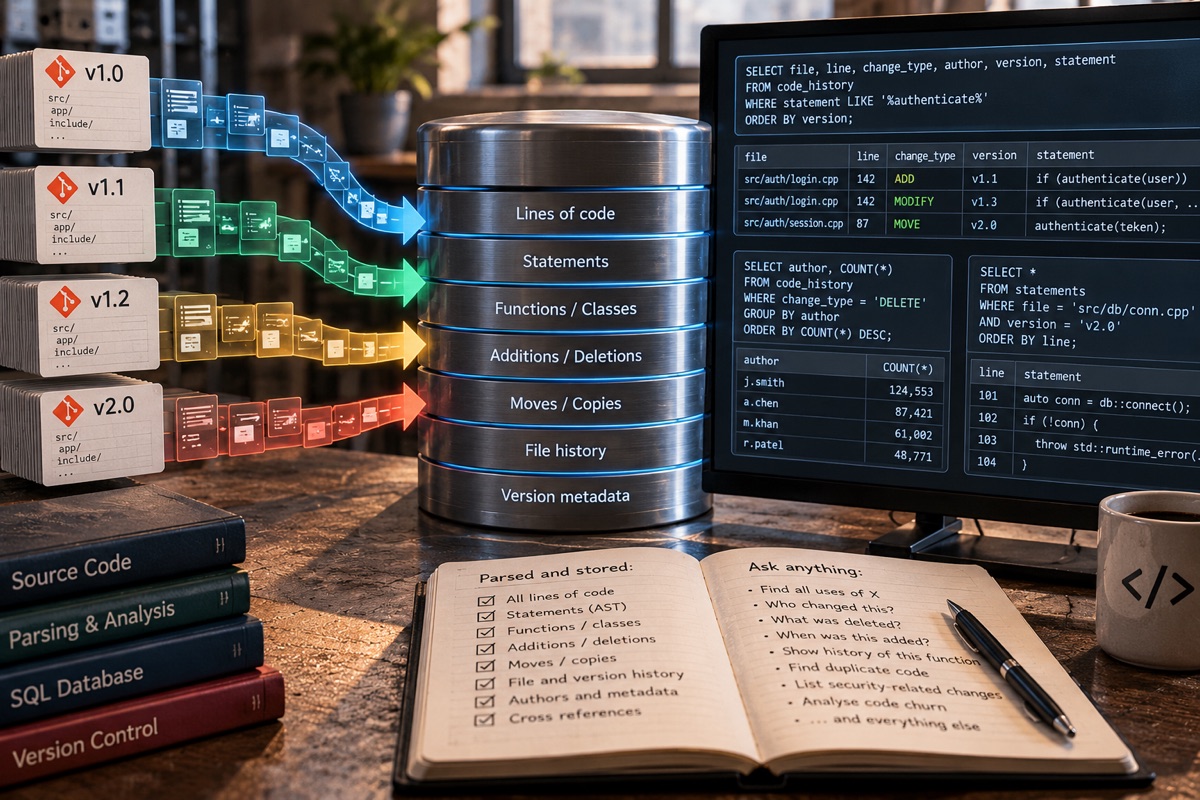
Every CodeDelta scan writes its measurements to one SQLite file: projects, scans, per-file churn, the statements behind the diff viewer and AI scores. History, Trend, the executive summary and every comparison read from that file.
Lose the file and the history is gone. The Data Centre backs it up, checks it and shows what it holds.
Download free WHAT IT CAN TELL YOU →What it can tell you
| Question | Answer from |
|---|---|
| What changed in each scan, and by how much? | History tab: one row per scan, click for its report. |
| Is churn falling before the release? | Trend tab: CRN_SLOC and CRN_LLOC over time. |
| What does management need to see? | trend: a one-page summary with trend arrows and charts. |
| Which files keep being reworked? | The per-file rows: one per file, per scan. |
| How have the AI scores moved? | The AI scores kept for every AI code scan. |
| Anything else? | Export scans (CSV), or query the file with any SQLite tool. |
An example: five years of Erlang/OTP
Erlang is a programming language. Erlang/OTP is its open-source runtime, standard library and tools, originally developed at Ericsson: the platform behind telecom infrastructure and some of the world’s largest messaging systems. More: Scanning Erlang/OTP.
Five releases, 25.0 (May 2022) to 29.0 (May 2026), were scanned in pairs. Releases 26.0 to 29.0 each hold 3.1 to 3.9 million lines of code in 11,000 to 13,200 measured files. The four scans require a 12 MB database space: only measurements are stored, not the original code.
Across the four scans: 2,286,965 churned statements, of which 324,657 are in generated files, so true churn (TRUE_CHURN) is 1,962,308.
Which files changed in every release? 632 of them. The ten with the most churn:
| File | Kind | Churned statements (CRN_LLOC) |
|---|---|---|
lib/stdlib/src/erl_parse.erl | Generated | 42,752 |
lib/kernel/test/socket_SUITE.erl | Hand-written | 42,027 |
lib/stdlib/src/unicode_util.erl | Generated | 26,149 |
erts/preloaded/src/erlang.erl | Hand-written | 9,217 |
lib/ssl/src/ssl.erl | Hand-written | 7,224 |
lib/kernel/src/socket.erl | Hand-written | 5,713 |
erts/configure | Generated | 4,876 |
lib/wx/src/gen/gl.erl | Generated | 4,269 |
lib/stdlib/src/gen_statem.erl | Hand-written | 4,013 |
lib/kernel/test/gen_tcp_misc_SUITE.erl | Hand-written | 3,837 |
CodeDelta marks four of them as generated from the stamp in their first lines (erl_parse.erl says it is built from erl_parse.yrl), so their churn counts as generated churn, not true churn.
What was deleted, and when?
| Release | Files deleted | Statements deleted |
|---|---|---|
| OTP 26.0 | 196 | 133,908 |
| OTP 27.0 | 2,580 | 1,061,764 |
| OTP 28.0 | 144 | 40,559 |
| OTP 29.0 | 75 | 11,476 |
OTP 27.0: what was deleted? Mostly XML documentation: 2,281 of the 2,288 XML files sat in doc/ folders.
| Kind of file | Files deleted |
|---|---|
| XML | 2,288 |
| Unclassified text | 144 |
| Make | 82 |
| Erlang | 34 |
Where? The eight folders with the most deleted files:
| Folder | Files deleted |
|---|---|
lib/wx | 729 |
lib/stdlib | 228 |
system/doc | 167 |
lib/kernel | 140 |
lib/snmp | 120 |
erts/doc | 106 |
lib/erl_docgen | 101 |
lib/common_test | 94 |
Scanned with CodeDelta 2.6.4 from the release downloads on github.com/erlang/otp.
What can we make for you?
The database already keeps the statements of every scanned version, every file’s measurements in every scan, and every AI score. New tools can be built on it, for example:
- The history of one function across every release.
- Every change to security code, such as anything that calls authentication.
- What was deleted, and in which version.
- Copied code across the project.
- Who changed it, from git history.
We have all the code data. What else do you need? Tell us what we can make for you.
Saved and protected
- Backup before the first scan of the day or week, to any folder: external drive, network share or cloud-synced.
- Keeps 1 to 5 copies. Back up now at any time.
- Health check before every copy. A damaged database is never copied over a good one.
- Restore from any copy. The replaced database is kept beside it.
- Warnings when the database is on a network share, or the backup disk is too full.
What it holds
The card shows project names, scans, file measurements, AI scores, size and the last scan. Hover any figure for the details from your own database: each project’s scan count, scans in the last 7 and 30 days, the largest project.
Projects… lists the size of each project. Remove old scans keeps the latest ones and makes a backup first; Compact gives the space back to the disk.
Commands
| Command | What it does |
|---|---|
data-centre info | What the database holds, its copies, the next backup. |
data-centre check | Health check. |
data-centre backup | Check, then copy now. |
data-centre restore --copy N --yes | Restore copy N (1 = newest). |
data-centre projects | Size of each project. |
data-centre remove --project NAME --keep N --yes | Keep the latest N scans, after a backup. |
data-centre compact --yes | Give the space back to the disk. |
data-centre export --out FILE.csv | One row per scan. |
scan --backup-folder DIR --backup-every weekly --backup-keep 3 | Backup settings for a command-line scan. |
Each command runs as codedelta_server.py data-centre …. Without --yes, restore, remove and compact show what they would do.
Appendix: a fix this page exposed
Creating this page exposed an edge case in the engine, fixed in CodeDelta 2.6.4. Checking the page’s figures meant scanning large public code bases again, and npm/cli 10.9.0 → 11.0.0, scanned three times with nothing changed, gave three different totals: 5,892, 5,894 and 5,896 churned statements.
The cause was huge statements: whole test snapshots, each one statement of more than 64 KB. CodeDelta keeps the first 64 KB of a statement as text. In JavaScript, TypeScript, Dart, Perl, Ada and Oracle PL/SQL the byte after that text was left unset, so two identical statements could compare as different on one run and equal on the next. And in 18 languages a change past the first 64 KB was not counted at all; only the C family had been fixed, in July.
CodeDelta 2.6.4 fingerprints everything past 64 KB in every language, and the same input gives the same result on every run: npm/cli scores 5,887 churned statements every time. A test covering all 18 languages fails on 2.6.3, passes on 2.6.4, and runs before every release. The same exercise taught the engine more generated-file stamps, such as “Generated by GNU Autoconf”, so that output is counted as generated churn, not authored.
All parsing tools have bugs; continuous, extreme testing is how CodeDelta aims to have the fewest. Its test scans include Chromium (43.5 million lines), Erlang/OTP, Kubernetes and FFmpeg. Do other vendors push the boat out like this? Ask them.
Read more
User guide: Data Centre · Management brief · Downloads · Papers